MacBook Air
Apple's lowest-cost notebook starts at $999 with an M2 chip and 13.6-inch display. Updated M3 models start at $1,099 (13.6-inch) and $1,299 (15.3-inch).
Should You Buy a MacBook Air?
Apple refreshed the MacBook Air in March of 2024, which means now is the time to upgrade. The new 13-inch and 15-inch MacBook Air models feature faster M3 chips, with price and display size as the only significant differentiating factors between the two sizes. A refreshed MacBook Air is not expected until mid-2025.
The MacBook Air is Apple's most popular computer and it is the best machine for most people because it is ideal for day-to-day tasks. The exception would be those who need the MacBook Pro for more system intensive apps for video editing, photo editing, and 3D rendering.
Pricing on the M3 MacBook Air starts at $1,099 for the 13-inch version, but Apple is also selling the prior-generation M2 model starting at $999. If you don't need the performance gains introduced with the M3 chip, picking up the M2 MacBook Air is a good way to save some money while still getting great machine.
The M3 MacBook Air
Contents
Apple in March 2024 updated the MacBook Air line, refreshing the 13.6-inch and the 15.3-inch models. Both of the new MacBook Air machines include the M3 chip, which is built on an updated 3-nanometer process. With 13- and 15-inch options, the MacBook Air lineup is suitable for those who want portability and those who prefer larger displays, with no need for those who want a bigger screen to shell out more money for the MacBook Pro lineup.
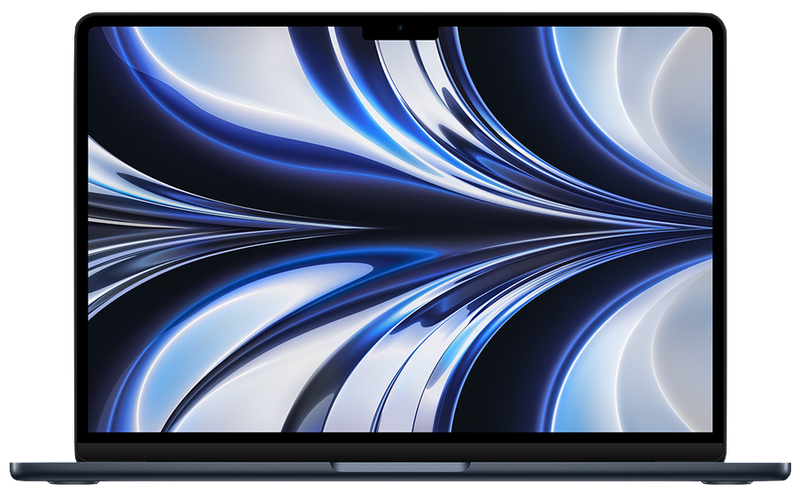
Apple did not change the design of the MacBook Air with the 2024 update, using the same design that was first introduced in 2022. The MacBook Air continues to feature the same uniform, flat body, similar to the MacBook Pro.
The 13-inch MacBook Air measures in at 11.97 inches wide and 8.46 inches tall. It is 11.3mm thick and it weighs 2.7 pounds. The 15-inch MacBook Air is 13.4 inches wide and 9.35 inches tall. It is 11.5mm thick, and at 3.3 pounds, it weighs a half pound more than the 13-inch model. It is, however, lighter than the 3.6 pound 14-inch MacBook Pro.
Thin black bezels surround a 13.6-inch Liquid Retina Display for the 13-inch model and a 15.3-inch Liquid Retina Display for the 15-inch model, both of which support 1 billion colors and feature 500 nits brightness.
There is a notch at the top of the MacBook Air display, which allows for more screen space around the 1080p FaceTime HD camera. Apple added a built-in four-speaker sound system for the 13-inch MacBook Air that supports spatial audio and wide stereo, while the 15-inch model has a six-speaker system, just like the prior-generation version. Both models include a three-microphone array.
The MacBook Air comes in Silver, Space Gray, Starlight, and Midnight, the latter of which is a dark blue shade that's almost black. The MacBook Air continues to feature a black keyboard with Touch ID and a large Force Touch trackpad.
Two USB-C ports are available on the MacBook Air along with a MagSafe port for charging purposes and a 3.5mm headphone jack with support for high-impedance headphones.
The battery in the MacBook Air lasts for up to 18 hours when watching movies or TV, and up to 15 hours when browsing the web. It supports fast-charging with an optional 70W USB-C power adapter. Both models have the same battery life.
The MacBook Air models use Apple's M3 chip, which replaces the prior-generation M2 chip. The M3 has an 8-core CPU with four high-efficiency cores and four high-performance cores along with an integrated GPU that has up to 10 cores.
The M3 is up to 30 percent faster than the prior-generation M2 chips, with the performance cores offering 15 percent faster speeds and the efficiency cores offering up to 30 percent faster speeds. There is support for up to 24GB unified memory.
Apple added hardware-accelerated ray tracing and mesh shading to the M3 to provide more accurate lighting and shadows in video games, and to make 3D design faster. There's also a media engine and a 16-core Neural Engine.
Pricing on the 13-inch MacBook Air with M3 chip starts at $1,099, while the 15-inch MacBook Air is priced starting at $1,299. There are SSD, memory, and processor upgrades available for both models at higher prices. Apple is continuing to sell the prior-generation M2 MacBook Air starting at $999 for those who want a more affordable option.
Note: See an error in this roundup or want to offer feedback? Send us an email here.
How to Buy
The M3 MacBook Air can be ordered from Apple's online store or Apple retail stores, with third-party retailers also selling the machine. Pricing starts at $1,099 for the 13-inch machine, while pricing on the 15-inch machine starts at $1,299.
Reviews
Reviewers praised the performance of the new M3 chip, which is up to 20 percent faster than the M2 chip in the prior-generation model.
Support for two external displays when in clamshell mode was also a favorite feature of reviewers because of its versatility. Two displays can be plugged in directly to the ports on the machine.
The Midnight version of the MacBook Air no longer has such a significant fingerprint problem thanks to the anodization method that Apple is using, but it's not perfect and does not eliminate all fingerprints.
Design
Apple redesigned the MacBook Air in 2022, introducing a flat MacBook Pro-style body that's the same thickness from front to back, a departure from the tapered look that previous models used. With the 2024 refresh, Apple is using that same design, and we won't be due for a new look for a few more years.

The 2024 MacBook Air models are available in 15.3-inch and 13.6-inch sizes, both of which use the same design. The two models look the same except for the screen size. The 13-inch MacBook Air is 11.97 inches long, 8.46 inches deep, 11.3mm thick, and it weighs in at 2.7 pounds.
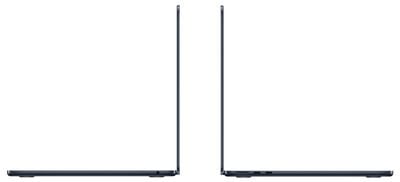
The 15-inch MacBook Air is, of course, larger. It is 11.5mm thick, so just a touch thicker than the 13-inch version. It is 13.4 inches long and 9.35 inches deep, and it is heavier at 3.3 pounds.
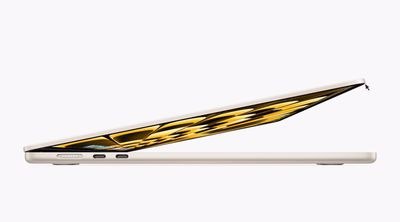
Two Thunderbolt/USB-C ports are available at the left side of both machines, along with a MagSafe charging port on the left and a 3.5mm headphone jack on the right. There are four rubber feet on the bottom of the machine, another MacBook Pro-style design touch.
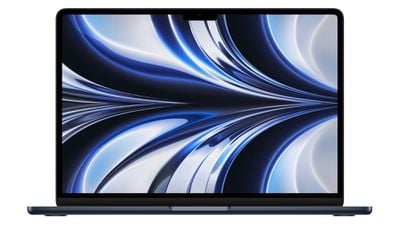
There are black bezels around the display, similar to the prior-generation model, and the MacBook Air features a black Magic Keyboard with no Touch Bar, along with a large Force Touch trackpad.
Apple sells the MacBook Air models in Silver, Space Gray, Starlight (a light gold), and Midnight, a dark blue color. The Midnight version of the MacBook Air has a new anodization seal to reduce fingerprints.
Keyboard and Trackpad
The 2024 MacBook Air uses the same Magic Keyboard from the prior-generation model. It features a scissor switch mechanism that is able to hold up to dust and particulates without failing, unlike the butterfly keyboards that Apple used in older Macs.
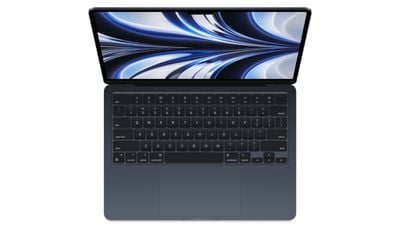
The scissor mechanism in the MacBook Air's keyboard offers 1mm of key travel and a stable key feel, plus it uses an Apple-designed rubber dome that stores more potential energy for a more responsive key press. The keyboard also features backlit keys controlled by an ambient light sensor to light up the keys in dark rooms. The MacBook Air has a full row of function keys with no Touch Bar.
Below the keyboard, there's a large Force Touch trackpad that is unchanged from prior models. The Force Touch trackpad has no traditional buttons and is powered by a set of Force Sensors, allowing users to press anywhere on the trackpad to get the same response. A Taptic Engine powered by magnets provides users with tactile feedback when using the trackpad, replacing the feel of a physical button press.
The Force Touch trackpad supports a light press, which is used as a regular click, along with a deeper press or "force click" as a separate gesture that does things like offer up definitions for a highlighted word.
Touch ID
The M3 MacBook Air has a Touch ID fingerprint sensor that's located next to the function keys at the top of the keyboard. Touch ID is powered by a Secure Enclave that keeps your fingerprint data and personal information safe.
Touch ID on the MacBook Air can be used instead of a password, unlocking the Mac when a finger is placed on the sensor. It also replaces a password for password-protected apps, and it can be used to make Apple Pay purchases in Safari.
Ports
The MacBook Air features two Thunderbolt 3/USB-C ports that support transfer speeds of up to 40Gb/s, plus there's a MagSafe 3 charging port.
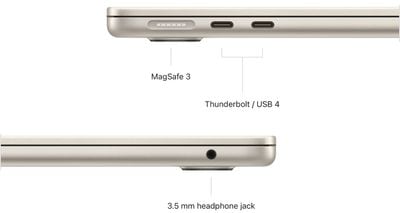
Apple also still includes a 3.5mm headphone jack with support for high-impedance headphones.
Display
There are two MacBook Air models, one with a display that measures in at 13.6 inches and one with a display that measures in at 15.3 inches. Both models have slim bezels and use "Liquid Retina Display Technology," with no new changes to display technology in 2024. Like the MacBook Pro, the MacBook Air has a notch to allow for more display space while still providing access to a 1080p webcam.
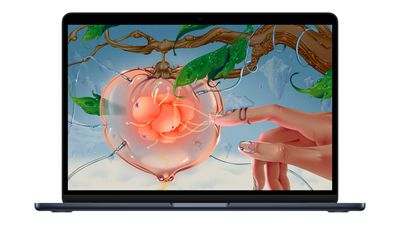
The 13-inch MacBook Air has a 2560 x 1664 resolution with 224 pixels per inch, while the 15-inch MacBook Air has a 2880 by 1864 resolution, also with 224 pixels per inch. Both displays offer support for 1 billion colors and P3 Wide color for vivid, true-to-life colors. Brightness maxes out at 500 nits.
The display in the MacBook Air uses True Tone, which is designed to tweak the color of the display to match the lighting in the room. True Tone works through a multi-channel ambient light sensor that's included in the MacBook Air models, which is able to determine both the brightness of the room and the color temperature.
After detecting the white balance, the MacBook Air is able to adjust both the color and intensity of the display to match the room's lighting for a more natural, paper-like viewing experience that also cuts down on eyestrain.
M3 Apple Silicon Chip
The MacBook Air models are equipped with Apple's M3 chip, built on the next-generation 3-nanometer process. This is the same M3 chip that Apple previously introduced in the MacBook Pro lineup.
The M3 chip has an 8-core CPU and up to a 10-core GPU. Entry-level models have an 8-core GPU, while higher-end models have the improved 10-core GPU.
According to Apple, the M3 represents the "biggest leap forward in graphics architecture ever for Apple silicon" with faster and more efficient GPU technology. The M3's GPU supports Dynamic Caching, hardware-accelerated ray tracing, and mesh shading.
Dynamic Caching allocates the use of local memory in hardware in real time, so only the exact amount of memory needed is used for each task. It increases the average utilization of the GPU, thereby increasing performance for demanding pro apps and games.
With hardware-accelerated ray tracing, light looks more realistic as it interacts with a scene, allowing for more physically accurate images. Game developers can use the ray-tracing and mesh shading for more accurate shadows and reflections as well as more efficient geometry processing.
CPU performance is up to 30 percent faster. The performance cores in the chip are up to 15 percent faster than the M2 performance cores, while the M3 efficiency cores are up to 30 percent faster than the M2 efficiency cores.
Benchmarks of the M3 chip in the MacBook Air featured a single-core score of 3157 and a multi-core score of 12020, which is a 20 percent improvement in single-core performance and an 18 percent improvement in multi-core performance compared to the M2 chip (which earned 2610/10120 scores).
Media Engine
Apple includes a media engine in its Apple silicon chips to speed up video processing while preserving battery life. The M3 offers dedicated acceleration for the ProRes video codec, along with video encode/decode engines and hardware accelerated support for H.264, HEVC, ProRes, and ProRes RAW.
Memory
The M3 uses a system-on-a-chip architecture with support for up to 24GB unified memory and up to 100GB/s memory bandwidth.
Custom Technologies
There's a 16-core Neural Engine built into the M3 chip that handles AI tasks and boosts camera performance alongside the custom image signal processor, plus there's a display engine that can drive multiple external displays.
The MacBook Air supports one external display at 6K resolution at up to 60Hz when open, or two external displays at 5K resolution at up to 60Hz when used in clamshell mode.
Storage
The base model MacBook Air machines have 256GB SSDs, but they can be updated with up to 2TB of storage. It is worth noting that Apple is now using two 128GB SSDs in the base model MacBook Air, so that machine no longer suffers from slower SSD speeds due to a single SSD module.
Battery Life
The 13-inch MacBook Air is equipped with a 52.6-watt-hour lithium-polymer battery, while the 15-inch MacBook Air has a 66.5-watt-hour lithium-polymer battery. Though the 15-inch MacBook Air's battery is larger, both machines last for up to 18 hours when watching movies using the Apple TV app, or up to 15 hours when wirelessly browsing the web.
The base model 13-inch MacBook Air ships with a 30W USB-C power adapter, but for an additional $20, customers can upgrade to a 35W Dual USB-C Port Compact Power Adapter or a 70W USB-C power adapter that supports fast charging. The higher-tier 13-inch models and all 15-inch MacBook Air models ships with the 35W Dual USB-C Power Adapter, but customers can opt for the 70W USB-C power adapter at no additional charge.
Other Features
Connectivity
The MacBook Air supports Wi-Fi 6E, which means it is able to connect to 6GHz networks. It also supports the Bluetooth 5.3 specification.
Speakers and Microphone
The 13-inch MacBook Air features a four-speaker sound system with improved stereo separation and vocal clarity from two tweeters and two ultra-thin woofers. There is more space in the 15-inch MacBook Air, so it is equipped with a six-speaker sound system with force-cancelling woofers for superior sound. The sound system is one of the few differences between the 13- and 15-inch models.
Both MacBook Air speaker systems support wide stereo sound and Spatial Audio. Spatial Audio is available when playing music or video with Dolby Atmos on the built-in speakers, and Spatial Audio with dynamic head tracking can be used with the third-generation AirPods, AirPods Pro, and AirPods Max.
The MacBook Air is also equipped with a three-microphone array with directional beamforming for enhanced voice clarity in audio and video calls. Apple says that the M3 models now feature Voice Isolation and Wide Spectrum microphone modes.
FaceTime Camera
The MacBook Air features the same 1080p FaceTime HD camera as the prior-generation models. It is powered by an advanced image signal processor with computational video that improves video quality, and Apple says it offers double the resolution and low-light performance of earlier generations.
Available Configurations and Upgrade Options
13-Inch MacBook Air
There are three stock 13-inch M3 MacBook Air configurations available from Apple, in Silver, Space Gray, Starlight, and Midnight.
- $1,099 - M3 chip with 8-core GPU, 8GB RAM, 256GB SSD.
- $1,299 - M3 chip with 10-core GPU, 8GB RAM, 512GB SSD.
- $1,499 - M3 chip with 10-core GPU, 16GB RAM, 512GB SSD.
Entry-Level 13-Inch MacBook Air Upgrade Options
- 10-core GPU - +$100
- 16GB Unified Memory - +$200
- 24GB Unified Memory - +$400
- 512GB SSD - +$200
- 1TB SSD - +$400
- 2TB SSD - +$800
- 35W Dual USB-C Power Adapter - +$20
- 70W USB-C Power Adapter - +$20
Middle-Tier 13-Inch MacBook Air Upgrade Options
- 16GB Unified Memory - +$200
- 24GB Unified Memory - +$400
- 1TB SSD - +$200
- 2TB SSD - +$600
Higher-End 13-Inch MacBook Air Upgrade Options
- 24GB Unified Memory - +$200
- 1TB SSD - +$200
- 2TB SSD - +$600
15-Inch MacBook Air
There are three stock 15-inch MacBook Air configurations available from Apple as well.
- $1,299 - M3 chip with 10-core GPU, 8GB RAM, 256GB SSD.
- $1,499 - M3 chip with 10-core GPU, 8GB RAM, 512GB SSD.
- $1,699 - M3 chip with 10-core GPU, 16GB RAM, 512GB SSD.
Entry-Level 15-Inch MacBook Air Upgrade Options
- 16GB Unified Memory - +$200
- 24GB Unified Memory - +$400
- 512GB SSD - +$200
- 1TB SSD - +$400
- 2TB SSD - +$800
Middle-Tier 15-Inch MacBook Air Upgrade Options
- 16GB Unified Memory - +$200
- 24GB Unified Memory - +$400
- 1TB SSD - +$200
- 2TB SSD - +$600
Higher-End 15-Inch MacBook Air Upgrade Options
- 24GB Unified Memory - +$400
- 1TB SSD - +$200
- 2TB SSD - +$600
M2 MacBook Air
Apple is continuing to sell the prior-generation M2 MacBook Air alongside the M3 models, with the M2 MacBook Air available at a lower cost. The M2 MacBook Air is priced starting at $999, keeping the sub-$1000 price point for the MacBook Air line.
The M2 MacBook Air is only available in a 13.6-inch size, and the entry-level version features an 8-core CPU, 8-core GPU, 8GB RAM, and a 256GB SSD.
There is also an improved M2 model available with an 8-core CPU, 10-core GPU, 8GB RAM, and 512GB of SSD storage. Additional memory and storage upgrades are available, maxing out at 24GB unified memory and a 2TB SSD.
What's Next For the MacBook Air
Apple is expected to update the MacBook Air lineup with the next-generation M4 chip in the spring of 2025. The M4 chip will feature a focus on AI, with Apple aiming to improve AI-related performance. The chip will be built on Apple's 3-nanometer process, and it could have improvements to performance and efficiency compared to the M3.
Rumors suggest that Apple will include an updated Neural Engine with more cores in the M4 chip.